Following on from the organ concert last month quite a number of you were interested in the tour of the inside of the organ which we gave during the event. I think it is perhaps a mystery to many how an organ works, and how it produces its sound, so here is a very simple (I hope!) guide to our organ – if you want to know more, then do feel free to ask!
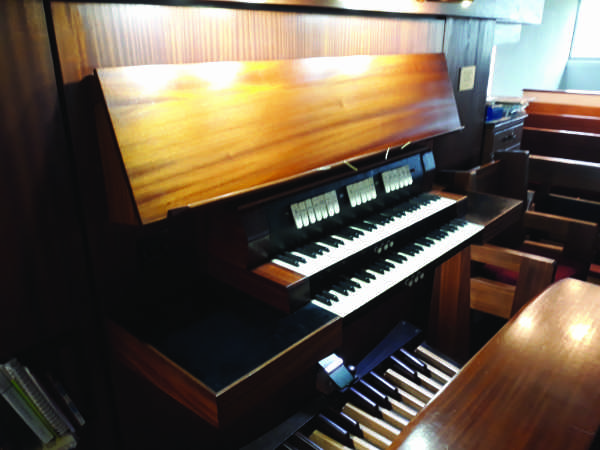
Organs, unlike pianos, tend to have more than one keyboard. As you can see from the close up of the console, ours has two keyboards (with 56 notes each) and a set of pedals (with 30 notes). The top keyboard is called ‘swell’ (because all the pipes it controls are in a large box with shutters on the front, which can be opened and closed to ‘swell’ the sound using the large green pedal in the centre of the pedals) and the bottom one ‘great’, as that is where all the main organ sounds are placed. Across the top of the keyboards are “stops”, in our case 15 of them (five for each keyboard, and five for the pedals), and they control the different sounds that an organ produces. The stops are designed in families, such as flutes, strings or trumpets. They are also at different pitches so that some are higher sounding than others to produce the complex sound of an organ.
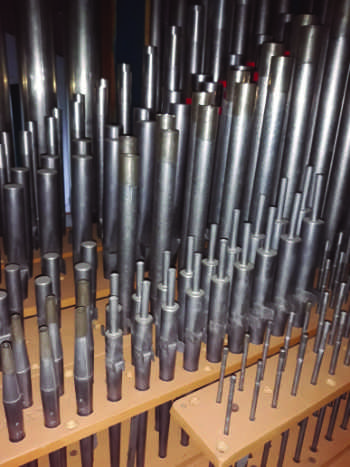
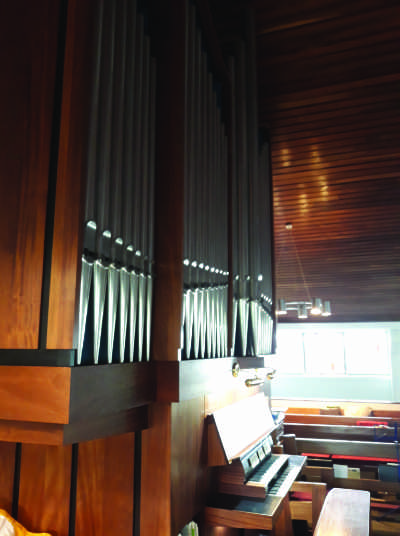
A pipe organ works on the idea that there is a pipe for every note of every stop. So some rough maths would give you the ball park figure that there are about 700 pipes in our organ and they range from the largest (which you can see in the middle of the photo of the instrument) to the smallest, about the size of a drinking straw (in the foreground of the internal photo below on the left).
Behind the back of the organ, in the tower, is a blower which blows wind into the instrument. That wind is then kept at a constant pressure in a soundboard on which all the pipes sit (in size order!). If you operate a stop and press down a key at the console it operates a solenoid magnet under that specific pipe, which then operates a valve and then lets in the wind so that pipe speaks.
As you look at the organ from the nave, most of the pipes you can see are operated by the pedals with the swell pipes behind on the right and the great on the left.
The pipes themselves are all differently shaped to produce different sounds. The photo (bottom right) shows the pipes of the great, and those which look like they have chimneys are flute sounding pipes, the others are what are called diapasons (the fundamental sound an organ makes)
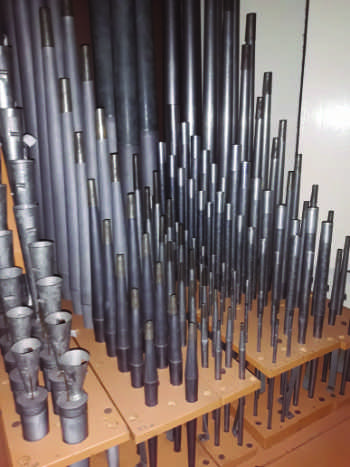
The photo (bottom centre) shows the pipes of the swell. Whilst many look the same, the ones on the left are trumpets and the pipes with tapering side are more string sounding.
The organ was built by Hill, Norman and Beard (HNB) in 1970 and follows a design developed by John Norman who was the Managing Director at the time. It is one of a unique organ design that was only built between 1965 and 1975, of which there are about 15 examples in the country. His multum in parvo design, which affectionately became known as the ‘bass-less organ’, uses a lot of borrowing between stops so that there are fewer larger pipes and hence the organ fits into a small space.
Surprisingly, there are three identical organs of this design in Portsmouth – ours, Hambledon Church and Waterlooville Baptist Church. Those with long memories might remember that our previous organ was damaged beyond repair during the 1969/70 enlargement of the church and the tale goes that Lucy Johnson, the organist at the time, went to play for a funeral at Hambledon and came back saying “we must have one of those”! The rest as they say is history!